
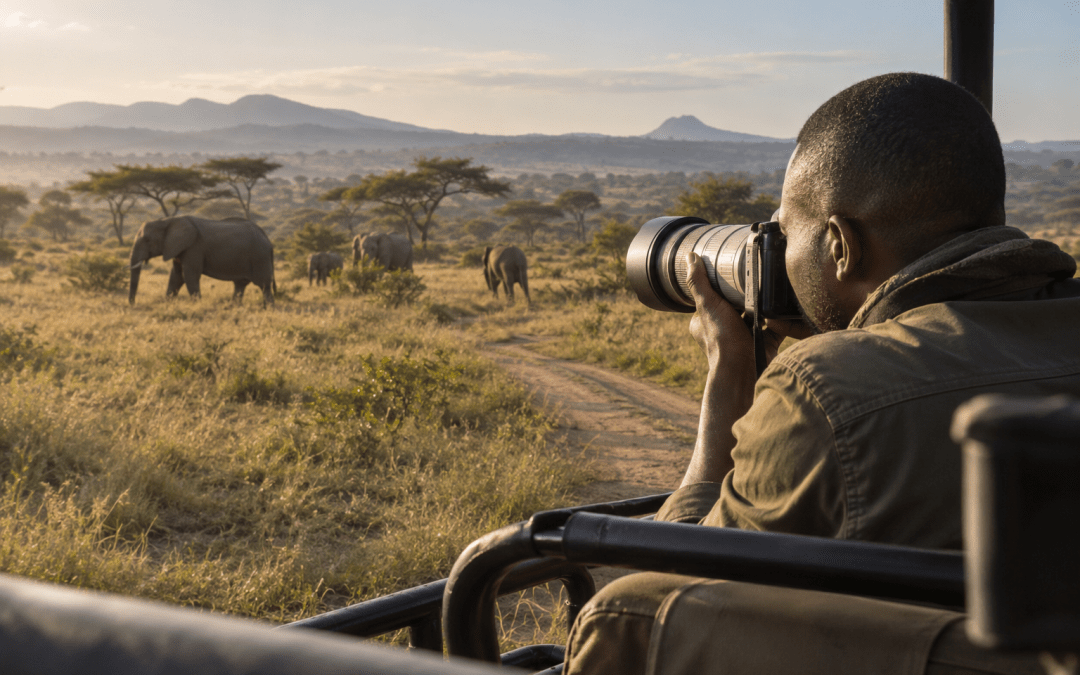
East Africa is wonderfully unpredictable. One moment, you may be photographing an elephant against a wide savannah; the next, a leopard appears briefly between the trees. In the forests of Uganda or Rwanda, the challenge changes again as you photograph primates beneath a thick canopy.
The best safari camera is therefore not necessarily the most expensive one. It is the camera you can carry comfortably, operate quickly and trust when an unforgettable moment appears.
Start With the Kind of Photographer You Are
If photography is not the main purpose of your safari, a modern smartphone may be enough for landscapes, people, meals and animals close to the vehicle. It is light, familiar and always ready.
A compact camera with a strong optical zoom is a useful step up. It brings distant wildlife closer without requiring you to carry several lenses.
For travellers who want greater control and higher image quality, a mirrorless or DSLR camera is the strongest option. Mirrorless cameras are generally lighter and offer fast autofocus, while DSLRs remain dependable choices with excellent battery life and a wide selection of lenses.
Whichever system you choose, practise with it before travelling. A safari is not the ideal place to begin searching through unfamiliar menus.
The Most Useful Lens for a Safari
Wild animals are often farther away than they appear in professional photographs. A telephoto zoom lens allows you to frame them properly while maintaining a respectful distance.
A lens reaching approximately 300mm or more is useful for most game drives. Longer lenses are especially valuable when photographing birds, leopards or animals on open plains.
Do not pack only a telephoto lens, however. A standard or wide-angle lens is ideal for scenery, lodges, people and environmental photographs that show wildlife within the wider landscape. A combination such as a wide-to-standard zoom and a telephoto zoom will cover most situations without making your camera bag unnecessarily heavy.
Consider the Type of Safari
Different East African experiences create different photography challenges.
On savannah game drives in the Maasai Mara, Serengeti, Queen Elizabeth or Akagera, you will often photograph from inside a vehicle. A bean bag can provide better support than a tripod, which may be difficult to position when several guests are sharing the vehicle.
Gorilla and chimpanzee trekking requires a lighter approach. You may walk through steep, wet or densely vegetated forest before reaching the primates. Carry one camera body and a versatile lens rather than a heavy collection of equipment. A lens with good low-light performance helps beneath the forest canopy, while a waterproof cover protects your gear from sudden rain.
Flash photography should not be used around gorillas or other sensitive wildlife. Always follow the instructions of your ranger or guide.
Prepare for Dust, Rain and Long Days
East African conditions can change quickly. Roads may be dusty during the dry season, while forest areas and afternoon storms can bring unexpected rain.
Pack a protective camera cover, lens cloth, small dust blower and a secure padded bag. Avoid changing lenses unnecessarily in dusty conditions because particles can easily reach the camera sensor.
You should also carry spare batteries and more memory-card capacity than you think you will need. Charging facilities may be limited in remote camps, and a busy wildlife sighting can fill a card surprisingly quickly.
Where possible, back up your photographs during the journey using a laptop, portable drive or cloud storage.
Keep Your Settings Simple
Wildlife rarely waits for you to prepare. Select settings that help you react quickly.
A fast shutter speed is useful for moving animals and birds, while continuous autofocus helps the camera follow a subject. Burst mode can increase your chances of capturing the strongest moment during action.
Early mornings, forest treks and evening game drives may require a higher ISO. A slightly grainy photograph is usually better than a blurred one caused by a shutter speed that was too slow.
Most importantly, learn how to adjust focus, shutter speed and exposure without taking your attention away from the scene.
Photograph With Respect
Good safari photography begins with responsible behaviour. Keep your voice low, avoid sudden movements and never pressure a guide to move too close to an animal.
Allow other guests space to enjoy the sighting, and remember to occasionally lower the camera. Not every moment needs to be viewed through a screen or viewfinder.
The finest safari photographs are not always the closest or most technically perfect. They are the images that capture the atmosphere of the journey: the changing light, the scale of the landscape and the character of the wildlife encountered along the way.
A Simple Safari Photography Checklist
Before leaving, confirm that you have:
- A camera or smartphone you know how to operate
- A telephoto or optical zoom for distant wildlife
- A wider lens for scenery and people
- Spare batteries and memory cards
- A padded, weather-resistant camera bag
- Lens cloths and a dust blower
- A rain cover
- A bean bag or compact support
- A reliable way to back up your photographs
With a practical setup and a little preparation, you can spend less time managing equipment and more time experiencing East Africa as it unfolds before you. The recommended equipment categories, focal lengths and handling considerations also align with established safari-photography guidance.