
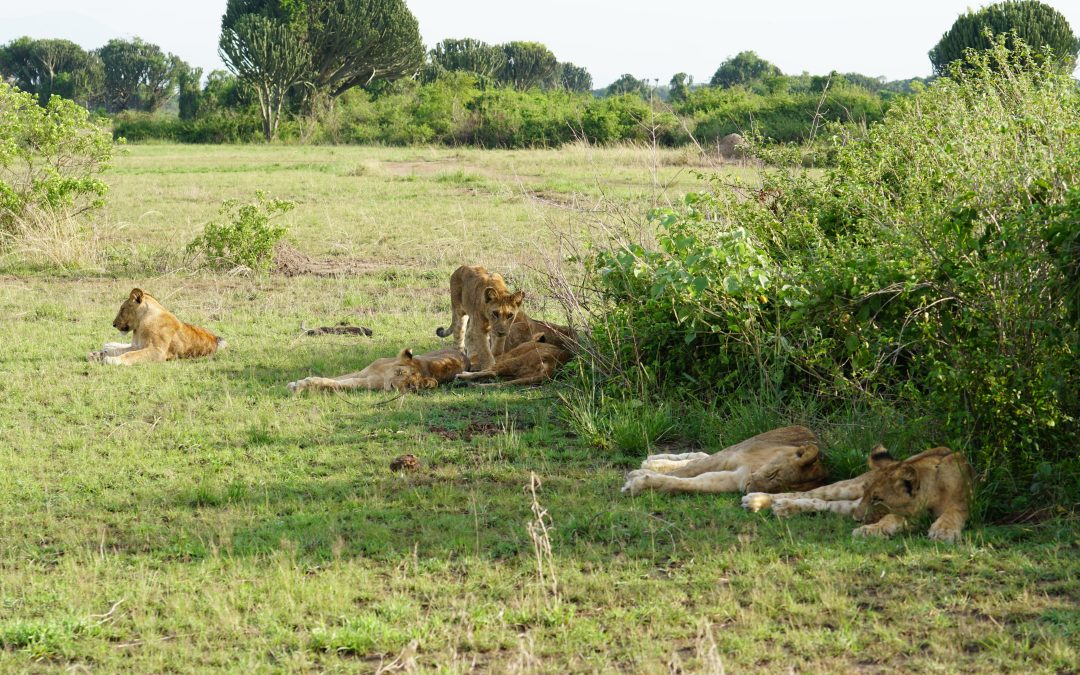
Queen Elizabeth National Park is a place where almost every turn reveals a different landscape. Open savannah gives way to crater lakes, wetlands, woodland and tropical forest, while the Rwenzori Mountains rise along the distant horizon.
Located in western Uganda, the park covers nearly 2,000 square kilometres between Lakes George and Edward. Its variety of habitats supports an equally impressive range of wildlife, making it one of the country’s most rewarding safari destinations.
Wildlife on the Kasenyi Plains
The Kasenyi Plains are among the park’s best areas for traditional game drives. Herds of Uganda kobs graze across the open grasslands, attracting lions and other predators.
Visitors may also encounter elephants, buffaloes, warthogs, waterbucks, leopards, hyenas and several species of antelope. Early mornings and late afternoons are especially rewarding, when temperatures are cooler and wildlife becomes more active.
Sightings are never guaranteed, but the changing terrain ensures that every drive brings a new opportunity.
A Boat Safari on the Kazinga Channel
The Kazinga Channel connects Lake George and Lake Edward, creating one of Queen Elizabeth National Park’s greatest wildlife-viewing areas.
During a boat cruise, travellers can watch hippos resting in the shallows, Nile crocodiles along the banks and elephants arriving at the water to drink. Buffaloes, antelopes and monitor lizards are also frequently seen around the shoreline.
The channel is approximately 40 kilometres long and attracts an extraordinary variety of waterbirds, including African fish eagles, kingfishers, pelicans and saddle-billed storks.
The Tree-Climbing Lions of Ishasha
In the remote southern section of the park lies Ishasha, a region known for its famous tree-climbing lions.
These lions are occasionally seen resting among the branches of large fig trees, looking out across the plains below. The reasons behind this unusual behaviour are still debated, but the elevated branches may provide relief from insects, cooler resting places or better views of the surrounding landscape.
Finding them requires patience, and their position is never predictable. That uncertainty makes a successful sighting even more memorable.
Primates in Kyambura Gorge
Kyambura Gorge offers a striking contrast to the surrounding savannah. Often described as a forest hidden beneath the plains, the gorge contains dense vegetation shaped by the Kyambura River.
Guided chimpanzee tracking takes visitors into this sunken forest in search of habituated chimpanzees. Other primates may include black-and-white colobus monkeys, red-tailed monkeys, vervet monkeys and olive baboons.
Chimpanzee sightings can be less predictable than in Uganda’s larger primate destinations, but the gorge itself makes the experience worthwhile.
Crater Lakes and Remarkable Scenery
Queen Elizabeth National Park is surrounded by evidence of ancient volcanic activity. The Katwe explosion craters create a dramatic landscape of steep-sided basins, grasslands and crater lakes.
Some viewpoints offer sweeping panoramas across the park, with the Rwenzori Mountains visible on clear days. Lake Katwe, located near the park, is also known for traditional salt extraction that has supported surrounding communities for generations.
A Paradise for Birdwatchers
With more than 600 recorded bird species, Queen Elizabeth is one of Uganda’s richest birdwatching destinations.
Its lakes, forests, wetlands and grasslands attract an impressive mixture of resident and migratory birds. Even travellers who do not consider themselves birdwatchers often find the park’s eagles, storks, kingfishers and colourful smaller species impossible to ignore.
When Is the Best Time to Visit?
Queen Elizabeth National Park can be visited throughout the year. The drier periods from June to August and December to February generally provide easier driving conditions and good wildlife viewing around permanent water sources.
The wetter months bring greener scenery, dramatic skies and excellent birding. Some roads may become muddy, but the park feels particularly beautiful and alive during this time.
Why Visit Queen Elizabeth National Park?
Few destinations combine so many experiences in one journey. A traveller can begin the day searching for lions on the plains, cruise past hippos in the afternoon and watch the sun set over volcanic craters.
Its wildlife is impressive, but its variety is what makes Queen Elizabeth National Park truly special. It is not one landscape or one safari experience—it is many different worlds brought together within a single remarkable park.